EV Charging Time and Cost Calculator
Estimate EV charging time and electricity cost using battery capacity, state of charge, charging power, efficiency, and utility-rate inputs. The calculator shows its assumptions so you can compare charging scenarios more clearly.

Interactive tool
Charging time and cost calculator
Results use deterministic rules and the verified data version shown below. Confirm vehicle and electrical requirements with the manufacturer and a licensed electrician.
Data version: 2026-08-09
Use the EV charging time calculator to estimate how long a charging session may take and how much electricity it may cost. Enter the vehicle's usable battery capacity, starting and target state of charge, available charging power, charging efficiency, and electricity price. The result is an estimate rather than a promise because the vehicle, battery, circuit, charging equipment, and operating conditions can reduce actual power.
The calculator applies transparent arithmetic: stored battery energy equals usable battery capacity multiplied by the requested state-of-charge increase; estimated grid energy equals stored energy divided by the efficiency fraction; estimated time equals grid energy divided by charging power; and estimated cost equals grid energy multiplied by the electricity price. This makes it useful for comparing reasonable scenarios before evaluating equipment or planning a routine.
Battery/SOC
Begin with usable battery capacity in kilowatt-hours, then enter the starting and target state of charge, or SOC. Use usable capacity when it is available from reliable vehicle documentation. A total or nominal battery figure may not represent the energy the vehicle makes available for driving, so mixing those values can distort the estimate.
The calculator determines the requested SOC increase by subtracting the starting percentage from the target percentage. It then multiplies that percentage increase by usable battery capacity. For example, a hypothetical vehicle with 60 kWh of usable capacity charging from 30% to 80% needs a 50-percentage-point increase. The estimated energy stored in the battery is 30 kWh before charging losses are considered.
- Usable battery capacity: The energy capacity available for the calculation, entered in kWh.
- Starting SOC: The battery percentage at the beginning of the session.
- Target SOC: The battery percentage at which the planned session ends.
Use the same inputs when comparing chargers. Changing the battery or SOC assumptions at the same time as charging power makes the comparison less meaningful.
Vehicle AC limit
For AC charging, the vehicle can accept power only up to its own charging limit. A charging station with a higher advertised output does not force the vehicle to accept that full output. Before treating a result as realistic, confirm the applicable vehicle AC charging limit in current manufacturer documentation for the exact model and configuration.
The entered charging power should represent the lower practical limit in the charging path. Relevant constraints can include the vehicle, charging equipment, circuit, electrical service, or another operating restriction. If a charger can provide more power than the vehicle accepts, use the vehicle limit as the input. If the circuit or equipment provides less, use that lower value instead.
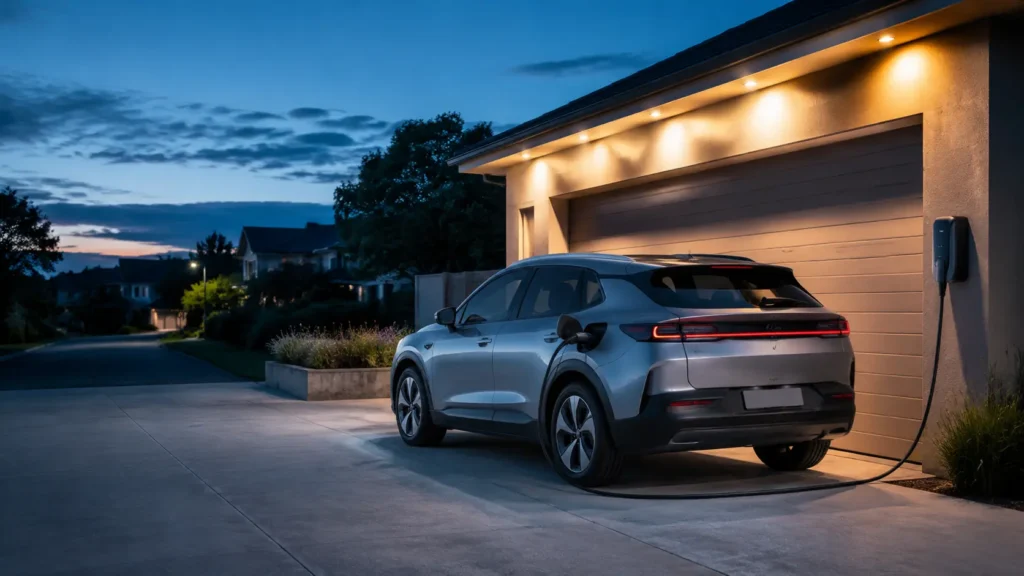
Do not infer compatibility from a connector photograph or a regional product image. Connector configuration, electrical ratings, certification, and U.S. availability require separate verification before purchase or installation.
Charger voltage/current
Voltage and current help establish the power potentially available from an AC charging setup, but the calculator ultimately needs charging power in kilowatts. Use a documented equipment output and a verified installation limit rather than relying on a product name or visual appearance.
A level 2 charging calculator is most useful when its power input reflects the complete charging path. The circuit, charging equipment, vehicle, and electrical service all matter. The smallest applicable limit generally controls the power available to the session, while actual power can still vary during charging.
- Confirm the charging equipment's documented output for the intended configuration.
- Confirm the vehicle's applicable AC charging limit.
- Confirm circuit and electrical-service suitability with qualified professionals where required.
- Use the lowest supported power figure as the calculator input.
Charging equipment is an electrical load. Installation, circuit sizing, permitting, inspection, and other safety requirements are outside this calculator's scope and should be addressed under applicable instructions and local requirements.

Efficiency
Not every kilowatt-hour drawn from the grid becomes stored battery energy. The efficiency input represents that relationship as a fraction or percentage. The calculator divides required stored energy by the efficiency fraction to estimate grid energy.
Using the hypothetical 30 kWh battery-energy requirement above, an entered efficiency of 90% produces an estimated grid-energy requirement of about 33.3 kWh. This is an illustration of the formula, not a verified efficiency figure for a particular vehicle or charger.
Efficiency can vary with equipment, battery condition, temperature, charging behavior, and supporting vehicle systems. When no verified session-specific value is available, test more than one reasonable assumption and view the results as a range. Avoid presenting a single calculated value as measured performance.
Utility rate/TOU
Enter an electricity price in dollars per kilowatt-hour. The EV charging cost calculator multiplies estimated grid energy by that rate. Use a rate that reflects the period when charging is expected to occur and check current utility information before making a financial decision.
Time-of-use, or TOU, pricing can assign different rates to different periods. If a session crosses rate periods, run separate scenarios or divide the estimated grid energy according to a reasonable schedule. Bills may also contain fixed charges, taxes, demand-related charges, credits, or other items that a simple per-kWh calculation does not capture.
To explore EV charge cost per month, estimate grid energy per typical session and multiply it by the expected number of sessions. Alternatively, estimate the total monthly battery energy needed, adjust it for the chosen efficiency assumption, and multiply by the applicable electricity rate. Keep this estimate separate from fixed household charges unless the tool explicitly includes them.
Time/cost/range outputs
The time output divides estimated grid energy by the entered charging power. The cost output multiplies the same grid energy by the entered electricity price. Because both results use grid energy, the efficiency assumption affects both estimated time and cost.
| Output | Calculation | Interpretation |
|---|---|---|
| Stored energy added | Usable capacity multiplied by SOC increase | Estimated energy added to the battery |
| Grid energy | Stored energy divided by efficiency | Estimated electricity drawn for the session |
| Charging time | Grid energy divided by charging power | Idealized duration at the entered power |
| Electricity cost | Grid energy multiplied by price per kWh | Energy-only session cost |
For a worked example, assume 30 kWh must be stored, efficiency is entered as 90%, charging power is 7.2 kW, and electricity costs $0.18 per kWh. Estimated grid energy is about 33.3 kWh, idealized charging time is about 4.6 hours, and estimated energy cost is about $6.00. These figures are hypothetical and rounded.
A range output requires an additional vehicle energy-consumption assumption. Because actual driving range depends on the vehicle and conditions, verify any consumption figure before using it. Weather, speed, terrain, accessories, load, and driving behavior can change real-world range. A home charging time calculator should therefore treat range as a planning estimate, not a guaranteed outcome.
Assumptions
The calculator is deterministic: the same inputs produce the same outputs. It assumes the entered charging power remains constant for the calculated period and that the efficiency value adequately represents the session. Real charging can be slower because the vehicle, battery SOC, temperature, circuit, charging equipment, or electrical service may limit power.
Results do not establish vehicle compatibility, electrical suitability, product certification, installation approval, U.S. availability, pricing, warranty coverage, or expected performance. Confirm vehicle and equipment specifications using current official documentation. Confirm electrical and installation requirements before selecting or using charging equipment.
Data version: The factual basis and formulas supplied for this explanation were source-checked on August 16, 2026. Product data, utility rates, policies, and technical documentation can change, so current details still require verification.
For a useful comparison, preserve the battery and SOC inputs while changing one variable at a time. Compare charging-power options with the same electricity rate, or compare rate periods with the same power. Record the assumptions with each result so another person can understand what the estimate includes.

Frequently asked questions
Why can actual charging take longer than the estimate?
The estimate assumes charging continues at the entered power. Actual power can be limited by the vehicle, battery SOC, temperature, circuit, electrical service, or charging equipment. Any reduction in average power increases session time.
Should I enter charger power or the vehicle's charging limit?
Enter the lowest applicable power limit in the charging path. If the vehicle accepts less power than the equipment can provide, use the vehicle limit. If the equipment or circuit provides less, use that lower supported value.
Does the cost result equal the amount added to my utility bill?
Not necessarily. The result estimates energy cost from grid energy and the entered per-kWh price. It may exclude fixed charges, taxes, credits, demand-related charges, or rate changes during the session.
Can I compare home charging with another charging option?
Yes, if you have verified power and price inputs for each scenario. Keep battery capacity, starting SOC, target SOC, and efficiency assumptions consistent where appropriate, then compare time and energy cost. Do not assume that pricing structures are equivalent.
Can the calculator confirm which charger I should buy?
No. It can clarify how charging power affects estimated time and how electricity price affects estimated cost. Before purchase, separately confirm vehicle compatibility, connector requirements, electrical capacity, installation requirements, product documentation, certification, current price, warranty terms, and U.S. availability.
Sources and review notes
Evidence basis: Official-source research. Sources checked: 2026-08-16.