Level 1 vs Level 2 EV Charging
Compare Level 1 and Level 2 EV charging by voltage, power, charging time, circuit needs, installation, and the situations each option fits best.
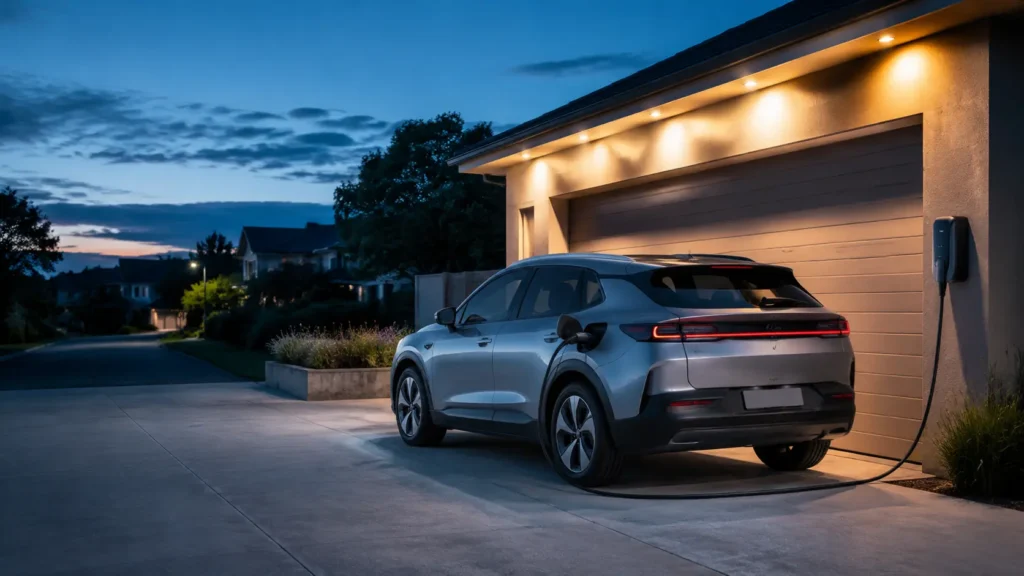
When preparing to charge an electric vehicle at home, understanding the differences in level 1 vs level 2 charging is essential for matching your daily driving habits with the right electrical setup. In the United States, residential charging relies primarily on standard household current or upgraded 240-volt circuits. Knowing how these options differ in power output, installation requirements, and refueling speed helps you determine whether a basic wall outlet is sufficient or if an upgraded home station is necessary.
AC Level 1 charging operates on standard 120 V electrical service, utilizing the same common household outlets found throughout any residential property. Because it draws from a standard branch circuit, it requires no specialized electrical work, making it immediately accessible for anyone with an appropriate, dedicated outlet near their parking space. However, its power delivery is modest, typically providing between 1 and 2 kilowatts of usable energy.
AC Level 2 charging relies on 240 V service, matching the voltage used by larger household appliances such as electric ranges or clothes dryers. By supplying higher voltage and greater amperage, Level 2 equipment delivers significantly more electrical power to the vehicle, usually ranging from 3 kW to over 19 kW depending on the hardware and the vehicle's onboard charger capacity. This substantial increase in power output dramatically reduces replenishment times for depleted battery packs.
Speed table
Comparing charging speeds side by side clarifies how much faster a 240V setup replenishes energy compared to a standard 120V connection. The table below outlines the general characteristics of both systems under typical residential conditions.
Daily miles
Evaluating your daily miles is the most practical way to assess whether basic home equipment can support your routine. According to data and general oversight from the U.S. Department of Energy, many drivers who travel average daily distances can fully recover their energy usage overnight using Level 1 equipment, provided the vehicle remains plugged in for an extended duration.
If your daily commute is modest—for example, under 30 or 40 miles round trip—an overnight window of 10 to 12 hours on a 120 V outlet can easily restore that energy. Conversely, drivers with lengthy commutes, unpredictable schedules, multiple electric vehicles in the household, or larger battery packs often find that overnight recovery on Level 1 leaves them with an incomplete charge by morning. In those scenarios, exploring whether level 2 is worth it becomes a priority for maintaining a reliable daily routine.
Outlet/circuit
Electrical infrastructure dictates what equipment you can safely plug in or install. Reviewing your panel capacity and existing wiring prevents overloaded circuits and ensures safe operation.
120V Circuit Requirements
Level 1 equipment connects directly to a standard NEMA 5-15 or NEMA 5-20 outlet. To ensure safety and prevent tripped breakers, the National Electrical Code and standard safety guidelines strongly recommend a dedicated branch circuit where no other heavy loads share the line.
240V Circuit Requirements
Level 2 equipment requires a dedicated 240 V circuit, similar to those used for heavy appliances. This installation typically involves running heavy-gauge copper wiring from your main electrical panel to a hardwired unit or a specialized receptacle such as a NEMA 14-50 or NEMA 6-50.
Cost
Financial considerations involve both upfront hardware expenses and long-term electrical work. Understanding the cost components helps set realistic expectations.
The hardware for Level 1 is usually included with the electric vehicle purchase as a portable cord set, meaning zero initial equipment cost if you use an existing outlet. Level 2 requires purchasing a dedicated wall-mounted unit or portable high-voltage charger, which varies in price depending on features, amperage ratings, and smart connectivity.
Beyond hardware, electrical labor represents a major variable in total expenses. While Level 1 incurs no installation fees if a suitable outlet is nearby, Level 2 projects frequently require professional labor, permits, and potentially a panel upgrade if your home's electrical service capacity is fully utilized.

Installation
Proper installation ensures compliance with local codes and protects your home and vehicle from electrical hazards.
Evaluating Electrical Capacity
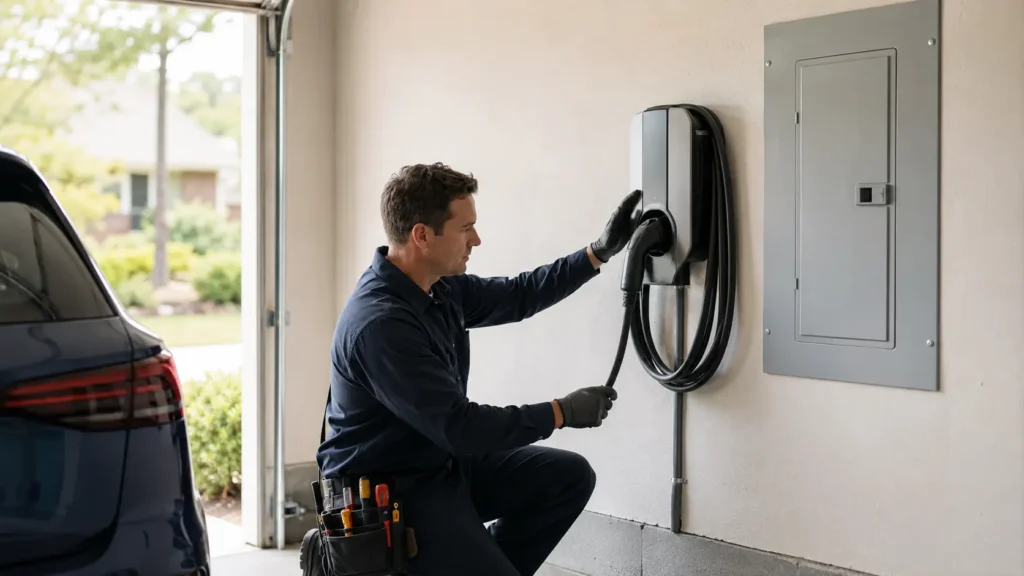
Before purchasing or mounting high-voltage equipment, a qualified electrician should evaluate your home's total electrical service capacity. Homes with older 100-amp panels may lack the spare amperage needed for a continuous heavy load without risking overloads.
Permits and Local Codes
Home charging installations must comply with applicable local and state building codes. Many municipalities require permits and inspections for new 240V circuits to guarantee that wiring gauge, breaker sizing, and GFCI protection meet safety standards.
Renter/homeowner scenarios
Living arrangements heavily influence which charging strategy is most practical and achievable.
Homeowners
Homeowners have the freedom to upgrade electrical panels, install dedicated 240 V circuits, and mount permanent wall units in garages or exterior carports, making Level 2 integration straightforward over the long term.
Renters and Condo Residents
Renters, apartment dwellers, and condominium residents often rely on existing property infrastructure. If a dedicated 120 V outlet is accessible near assigned parking, Level 1 may provide a viable interim solution. When higher speeds are required in shared or rental housing, coordination with landlords or property management is necessary to explore communal charging options or authorized electrical upgrades.
Calculator
Estimating your specific home charging speed requires plugging a few basic variables into a mathematical formula. Charging time is determined by battery capacity, state of charge, and power delivery.
To estimate the hours required to replenish a battery from empty to full, divide the usable battery capacity in kilowatt-hours (kWh) by the power delivery of the charging equipment in kilowatts (kW). For example, a 60 kWh battery charged on a 1.4 kW Level 1 cord will take roughly 43 hours from zero, whereas the same battery charged on a 7.2 kW Level 2 unit requires approximately 8.3 hours. Keep in mind that real-world charging efficiency losses mean actual times are slightly longer.
Frequently asked questions
Can I plug a Level 2 charger into a standard wall outlet?
No. Level 2 charging requires 240-volt electrical service and a compatible high-voltage circuit, whereas standard wall outlets supply 120 volts.
Does fast home charging degrade the EV battery faster?
Typical home-level AC charging speeds, even at 240 volts, are considered moderate compared to high-power public DC fast chargers and have a minimal impact on overall battery longevity.
Do I need a professional electrician for Level 1 charging?
Usually no, provided you are plugging into a standard, sound, dedicated 120-volt outlet that meets local safety guidelines.
What factors influence actual home charging speeds?
Actual speeds depend on your vehicle's internal charger capability, battery temperature, state of charge, and the maximum power output of your charging equipment and electrical circuit.
Sources and review notes
Evidence basis: Official-source research. Sources checked: 2026-08-16.