How Much Does It Cost to Charge an EV at Home?
Estimate home EV charging costs using your electricity rate, the energy added to the battery, and a charging-efficiency assumption. Compare per-session, monthly, and time-of-use scenarios without relying on a national average.

The cost to charge an EV at home is the amount of electricity drawn from the grid multiplied by the electricity price that applies while the vehicle is charging. For a useful estimate, start with the kilowatt-hours added to the battery, adjust for charging losses, and multiply the resulting grid energy by your rate per kilowatt-hour.
There is no single current U.S. price that answers the question for every household. Electricity prices vary by region, generation mix, time of use, and charging location. Some utilities also offer time-of-use rates or other incentives. The most reliable estimate therefore uses your vehicle data, your driving pattern, and the rates shown on your own utility plan.
Formula
A practical home-charging calculation separates battery energy from grid energy. The battery receives part of the electricity drawn from the home, while the remainder is associated with charging losses. Entering an explicit efficiency assumption keeps that difference visible instead of hiding it inside a national estimate.
Grid energy in kWh = battery energy added in kWh divided by charging efficiency
Charging cost = grid energy in kWh multiplied by electricity price per kWh
Write efficiency as a decimal in the formula. For example, an assumed efficiency of 90% becomes 0.90. If 40 kWh is added to the battery under that assumption, the estimated grid draw is 40 divided by 0.90, or about 44.44 kWh. At an example rate of $0.16 per kWh, the session would cost about $7.11.
This example is arithmetic, not a claim about a particular vehicle, charger, utility, or typical U.S. rate. Replace all three inputs with values relevant to your situation.
| Input | What it represents | Where to get it |
|---|---|---|
| Battery energy added | Energy that reaches the vehicle battery during the session | Vehicle or charging records, when available, or a calculated estimate |
| Charging efficiency | The assumed share of grid energy that reaches the battery | A documented vehicle or charging value when available; otherwise use a clearly labeled planning assumption |
| Electricity price | The applicable cost for each kWh drawn during charging | Your utility bill, rate schedule, or utility account |
kWh rate
Your electricity price is usually the most location-specific input in an electric car charging cost estimate. Use the rate that actually applies to your home and charging period rather than a broad national figure.
Begin with a recent utility bill and the current rate information supplied by your utility. Determine whether the price is flat or changes by time period. Also check whether the displayed energy charge tells the whole story for the calculation. A bill may separate electricity-related amounts into multiple lines, and some charges may not increase in direct proportion to charging consumption.
For a quick marginal-cost estimate, identify the per-kWh charges that rise when you use an additional kWh. Fixed monthly charges generally remain payable whether or not the EV is charged, so including them can distort the cost of an additional charging session. Taxes, adjustments, tiers, and other bill elements may require closer review.
If your utility uses tiered pricing, additional EV consumption could fall into a different tier from your household's earlier usage. In that case, calculate with the rate expected to apply to the added electricity, or model more than one tier. Utility structures and incentives can change, so verify the current terms directly before using the result for a purchase or budget decision.
losses
The battery-energy increase and the electricity measured at the home are not necessarily the same quantity. A grid-based cost estimate should account for that difference through a charging-efficiency input.
Efficiency can vary with the vehicle, charging equipment, operating conditions, and the way a charging session is conducted. The supplied official-source facts do not establish one universal percentage for all U.S. home charging. For that reason, the calculator method on this page treats efficiency as a user-entered assumption.
To see why the assumption matters, compare the grid energy needed to add 50 kWh to a battery:
| Assumed efficiency | Estimated grid energy | Cost at an example $0.18 per kWh |
|---|---|---|
| 95% | 52.63 kWh | $9.47 |
| 90% | 55.56 kWh | $10.00 |
| 85% | 58.82 kWh | $10.59 |
These are planning scenarios, not verified performance figures for any product. If your vehicle, charging station, or energy-monitoring system reports grid energy directly, use that measured amount for retrospective cost calculations and avoid applying a second loss adjustment.
battery amount
You do not need to assume that every home charge fills the entire battery. The relevant input is the amount of energy added during the session or over the month.
If reliable charging records provide battery energy added or grid energy consumed, those records offer the clearest starting point. Without records, you can estimate battery energy from a change in state of charge:
Estimated battery energy added = usable battery capacity multiplied by the percentage-point increase expressed as a decimal
For example, moving from 30% to 70% represents a 40-percentage-point increase. With an assumed usable capacity of 75 kWh, the estimated battery addition would be 75 multiplied by 0.40, or 30 kWh. You would then divide by the chosen efficiency assumption before applying the electricity rate.
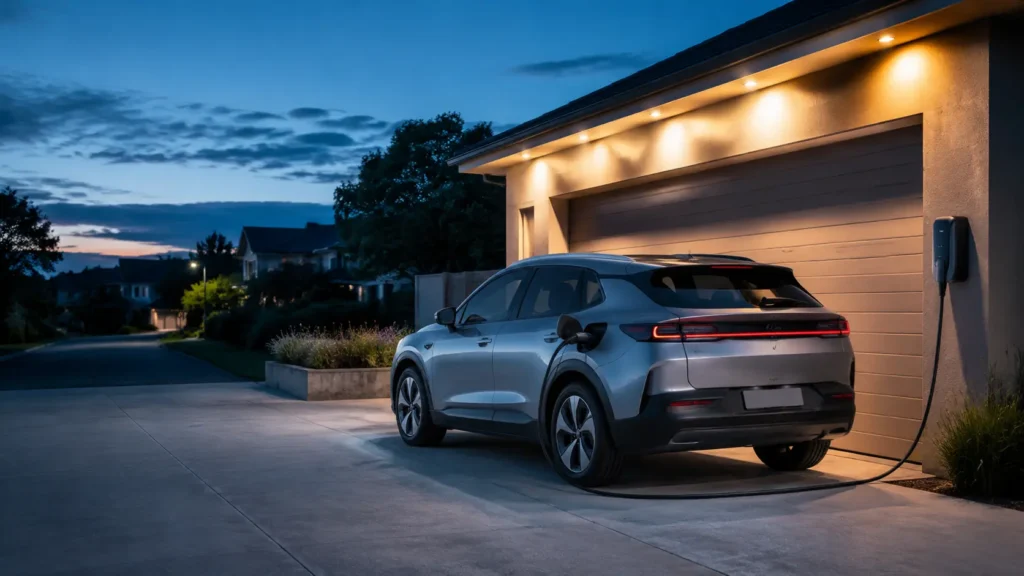
Confirm which capacity figure you are using. A published battery figure may not necessarily describe usable energy, and battery condition or vehicle behavior may affect an estimate. Do not infer capacity, charging limits, or compatibility from a product image.
For monthly budgeting, another approach is to total the energy from actual sessions. A driving-distance estimate can also be used when records are unavailable:
Monthly battery energy = monthly EV miles multiplied by estimated battery kWh per mile
If your vehicle displays miles per kWh, divide miles by that figure instead. Keep battery-side efficiency and grid-side charging losses separate so they are not counted twice.
TOU plans
Time-of-use plans assign different electricity prices to defined periods. Some utilities offer these plans or other incentives, but the hours, rates, eligibility rules, and enrollment terms are utility-specific. A time of use EV charging estimate should use the exact schedule for the household rather than generic peak and off-peak assumptions.
Compare plans using your complete household load, not only the vehicle. A lower charging-period rate can be useful, but electricity used by heating, cooling, water heating, cooking, or other equipment may also move into higher-priced periods. The appropriate comparison is the estimated total bill under each available plan.
Map charging to rate periods
Record when charging normally starts, how long it continues, and whether the vehicle or charging equipment can schedule it. Allocate expected kWh to the utility's defined periods. A session that crosses a rate boundary may need to be divided between two prices.
Compare realistic scenarios
Calculate at least a current-behavior scenario and a scheduled-charging scenario. Include the rest of the home's consumption when enough data is available. Also check whether weekends, holidays, seasons, or tiers are treated differently in the current utility schedule.
Verify before changing plans
Confirm the current rates, effective dates, eligibility conditions, and any incentive requirements with the utility. Do not assume that an EV-specific plan is automatically the lowest-cost option for every household.

monthly examples
The examples below show how the same method can compare monthly scenarios. They are not national price estimates or forecasts. Each row uses an illustrative monthly battery-energy amount, electricity rate, and charging-efficiency assumption.
| Scenario | Battery energy added | Efficiency assumption | Grid energy | Example rate | Estimated monthly cost |
|---|---|---|---|---|---|
| Lower monthly energy | 150 kWh | 90% | 166.67 kWh | $0.14/kWh | $23.33 |
| Moderate monthly energy | 250 kWh | 90% | 277.78 kWh | $0.18/kWh | $50.00 |
| Higher monthly energy | 400 kWh | 85% | 470.59 kWh | $0.22/kWh | $103.53 |
For the moderate example, divide 250 kWh by 0.90 to get 277.78 kWh from the grid. Multiplying 277.78 by $0.18 gives $50.00 after rounding. This transparent sequence makes it easier to replace one assumption at a time.
You can also estimate the cost per mile EV drivers may pay at home:
Grid electricity cost per mile = grid kWh per mile multiplied by electricity price per kWh
Suppose an illustrative vehicle uses 0.30 battery kWh per mile. At 90% charging efficiency, grid use would be about 0.333 kWh per mile. At an example price of $0.18 per kWh, the estimated electricity cost would be about $0.06 per mile. This excludes vehicle purchase, charging-equipment purchase, installation, maintenance, insurance, registration, and other ownership costs.
For a range rather than a single result, run the calculation with a lower and higher expected electricity price, efficiency assumption, and monthly energy amount. A range makes uncertainty visible and is usually more useful for budgeting than a precise-looking number based on weak inputs.
calculator
An EV charging cost calculator should expose its assumptions. The following procedure works for a single session, a month, or another period as long as all inputs cover the same period.
- Choose the calculation period. Decide whether you are estimating one charging session, one billing cycle, or a typical month.
- Enter battery energy added. Use charging records when available. Otherwise, estimate from usable battery capacity and the change in state of charge, or from distance and energy consumption.
- Enter charging efficiency. Use a documented value when one is available. If you use a planning assumption, label it clearly and test more than one value.
- Calculate grid energy. Divide battery energy added by charging efficiency expressed as a decimal. Skip this adjustment if the input already measures electricity drawn from the grid.
- Enter the applicable electricity price. Use the current utility rate for the period when charging occurs. Split energy across rate periods when necessary.
- Calculate charging cost. Multiply grid energy by the applicable price per kWh. Add the costs of separate time-of-use periods to obtain the total.
- Check the result. Confirm that percentages were converted to decimals, units are consistent, losses were not counted twice, and the rate was not mistaken for a fixed bill charge.
When comparing home-charging equipment, first establish the vehicle's requirements and the home's electrical conditions. Confirm vehicle and connector compatibility, supported charging limits, installation requirements, applicable safety credentials, and current utility-program conditions using verified documentation and qualified local guidance. Product imagery alone does not establish U.S. availability, certification, compatibility, or performance.
Common calculator mistakes
- Multiplying battery kWh by the rate without considering whether the energy figure is battery-side or grid-side.
- Using the full battery capacity when only part of the battery is replenished.
- Applying one off-peak rate to a session that spans multiple rate periods.
- Using a percentage such as 90 instead of its decimal form, 0.90.
- Adding charging losses to grid-energy data that already includes those losses.
- Treating an illustrative electricity price as a current local utility rate.
- Comparing utility plans using EV consumption while ignoring the rest of the household load.
source date
The official-source review for this guide was recorded on August 16, 2026. The verified source-grounded points are that home EV charging cost depends on electricity use and the applicable electricity price; electricity prices vary by region, generation mix, time of use, and charging location; and some utilities offer time-of-use rates or other incentives.
Electricity rates, utility programs, and plan terms can change. Check your current utility bill and official rate schedule before relying on an estimate. Vehicle-specific energy use, charging efficiency, battery capacity, equipment compatibility, electrical requirements, product availability, and purchase terms also require separate verification from appropriate current documentation.

Frequently asked questions
How do I calculate the cost of one home charging session?
Divide the battery energy added by the charging-efficiency assumption to estimate grid energy, then multiply grid energy by the applicable electricity price per kWh. If you already know grid energy for the session, multiply that amount directly by the rate and do not adjust for losses again.
Should I use battery capacity or energy added?
Use the energy actually added. Full usable battery capacity is relevant only when the session adds that entire amount. For a partial charge, estimate the added energy from charging records or the change in state of charge.
Why does my utility rate matter more than a national average?
Your bill is based on the rates and rules applicable to your household. Electricity prices vary by region and time of use, so a broad average may not represent the price of your next charging session.
Is charging at night always cheaper?
No. It is cheaper only when the applicable utility schedule assigns a lower rate to the hours in which charging occurs and the broader plan remains favorable for the household. Verify the exact periods and terms.
How can I estimate monthly home EV charging cost?
Total the battery energy added during the month, divide by the efficiency assumption, and multiply by the applicable electricity rate. If charging spans several rate periods, calculate each period separately and add the results.
Does the calculation include charger purchase or installation?
No. The formula estimates electricity consumption cost. Equipment, installation, electrical work, permits, maintenance, and other ownership expenses are separate and must be confirmed for the specific home, location, and product.
What should I verify before choosing a home charger?
Verify vehicle and connector compatibility, vehicle charging limits, the home's electrical conditions, installation requirements, applicable safety credentials, utility-program rules, and current commercial terms. Use documented information and qualified local guidance rather than inferring U.S. suitability from product imagery.
Sources and review notes
Evidence basis: Official-source research. Sources checked: 2026-08-16.