How to Choose a Portable EV Charger for Your Car
Choose a portable EV charger by matching it to your vehicle, connector, available outlet, circuit capacity, charging needs, environment, and documented safety requirements.

To understand how to choose a portable EV charger, start with your vehicle inlet, maximum AC charging rate, and the electrical outlets you can safely use. Then compare cable length, environmental protection, documented safety certification, portability, and warranty terms. A charger is only a practical choice when all of those factors work together.
For U.S. drivers, the central decision is usually whether the charger will be used with a standard 120-volt supply, a suitable 240-volt supply, or both. U.S. Department of Energy guidance distinguishes 120-volt Level 1 charging from faster residential 240-volt Level 2 charging. The right charging level depends on the vehicle, normal daily driving, available charging time, and the electrical capacity at each intended location.
Portable does not mean universally compatible. A connector that fits the car can still be paired with the wrong wall plug, an unsuitable circuit, or equipment whose safety status is unclear. Use the following framework to create a shortlist, and confirm product-specific details with current documentation before purchasing.
Vehicle
Begin with the exact year, make, model, and configuration of the electric vehicle or plug-in hybrid. Different configurations can have different inlets or charging capabilities, so a general statement about a brand or model family is not enough.
Record how the vehicle is normally used. Daily distance, the amount of time parked, access to charging at work, and the availability of public charging all affect the amount of energy that must be restored at home or while traveling. A driver who can remain plugged in overnight may have different requirements from one who has only a short charging window.
Build a vehicle charging profile
- Identify the vehicle precisely: Use the owner documentation or another official vehicle source to confirm the model year and configuration.
- Confirm the AC charging inlet: Do not choose from a product photograph or a brand assumption.
- Find the vehicle's AC charging limit: This establishes the highest AC power the vehicle can accept, subject to the available electrical supply.
- Estimate routine charging demand: Consider typical driving and parking time rather than planning only around an unusual long trip.
- Check charging controls: Confirm whether charging schedules or current limits are managed by the vehicle, charging equipment, or both.
This vehicle profile prevents overbuying based on a charger's advertised maximum and helps identify whether slower charging can still cover normal use.

connector
The vehicle-side connector must match the inlet used for AC charging. SAE J1772 and SAE J3400 define major North American conductive charging-coupler standards, but the applicable connector must still be confirmed for the specific vehicle.
Connector shape alone is not a complete compatibility check. Confirm the charging mode, any adapter requirements, and the vehicle manufacturer's instructions. An adapter adds another compatibility point and should not be treated as automatically appropriate merely because the parts appear to connect.
Questions to resolve before purchase
- Which inlet does this exact vehicle use for AC charging?
- Does the charger have a directly compatible vehicle connector?
- If an adapter is needed, is that use supported by the relevant vehicle and equipment documentation?
- Can the connector be inserted, removed, and stored without strain at the normal parking position?
Do not infer U.S. compatibility from a regional product image. Similar-looking equipment may use a different wall plug, connector, electrical rating, or compliance framework.
max AC rate
A vehicle's maximum AC charging rate limits how much AC power it can use. Buying equipment with a higher advertised output does not make the vehicle accept power beyond that vehicle limit. Actual charging is also constrained by the supply, circuit, equipment configuration, and operating conditions.
Use power ratings as a compatibility and planning input, not as a promise of constant charging performance. The practical goal is to select a charging rate that can restore the energy needed for routine driving within the available parking window.
Compare demand with charging time
Estimate how much driving must usually be replenished between charging sessions, then compare that need with the time the vehicle is parked. This calculation does not require pretending that every day is identical. A conservative normal-day estimate, plus a plan for occasional higher-demand days, is more useful than selecting equipment around the largest possible trip.
Confirm any product-specific amperage settings and power claims in current documentation. Do not assume that an adjustable charger will automatically select a safe current for every circuit.
outlet
The wall connection determines where a portable charger can actually be used. In the United States, 120-volt Level 1 and 240-volt Level 2 charging represent different supply arrangements and charging potential. The outlet and charger plug must match physically and electrically.
A plug that fits is not proof that the outlet, wiring, or circuit is appropriate for sustained charging. Before relying on an outlet at home, a workplace, or a travel destination, confirm the electrical arrangement and applicable requirements.
If one charger includes multiple wall-plug options, verify how each option changes the allowable input and charging output. Treat every plug configuration as a separate use case requiring confirmation.
circuit
The circuit is as important as the outlet. U.S. Department of Energy guidance recommends checking electrical capacity and applicable installation requirements for residential charging. A portable unit does not eliminate the need for an appropriate supply.
Confirm the complete electrical path
- Circuit capacity: Determine what the circuit is designed to support under applicable requirements.
- Other loads: Establish whether other outlets or equipment share the circuit.
- Outlet condition: A worn, damaged, loose, or overheating connection requires attention rather than continued charging.
- Equipment setting: Confirm that the charging current is appropriate for the supply and permitted configuration.
- Installation requirements: Check the rules and professional requirements that apply at the location.
Do not use extension cords, improvised adapters, or unverified conversion arrangements unless the relevant official instructions explicitly permit the complete setup. If circuit capacity, receptacle condition, or installation suitability is uncertain, obtain an assessment from a qualified electrical professional under local requirements.
cable
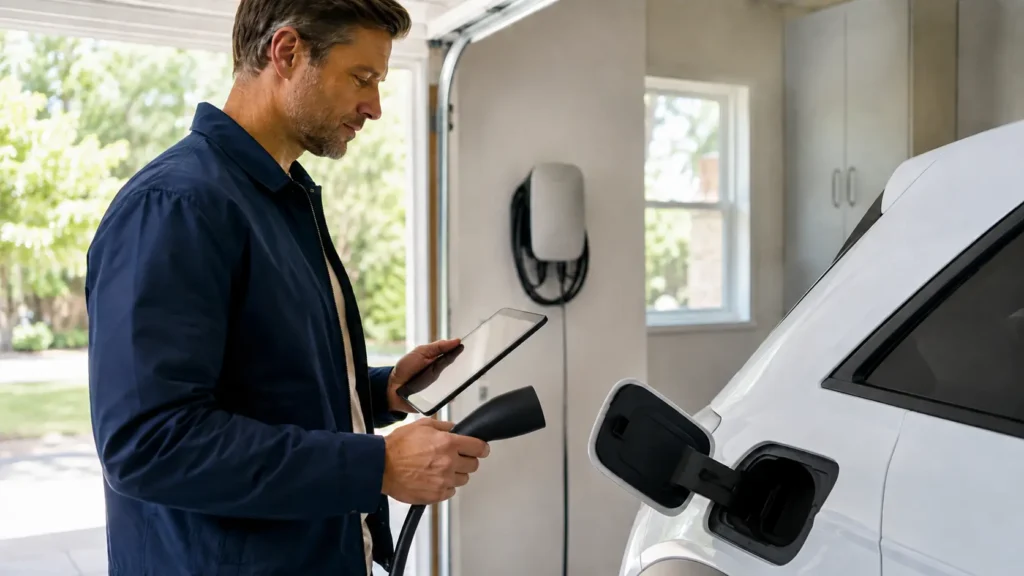
Cable length should allow the charger to reach the vehicle inlet without stretching, creating a trip hazard, crossing an unsafe area, or forcing the control unit and connectors to bear weight. Measure the real parking arrangement before comparing products.
Measure from the intended outlet to the inlet with the vehicle parked in its normal position. Account for routing around the rear or front of the vehicle, changes in parking orientation, garage doors, curbs, and the location where the charging unit will rest or hang.
Balance reach and portability
A longer cable can improve reach but also adds bulk and weight. A shorter cable is easier to pack but may make some outlets unusable. For a travel charger for an electric car, record both the minimum length needed at home and the likely routing at recurring destinations.
Also evaluate how the cable and connectors will be stored. They should be protected from damage, contamination, sharp bends, and vehicle traffic. Confirm product-specific handling and storage limits in the current instructions.
weather
If charging equipment may be used outdoors, verify the manufacturer's documented environmental limits and installation instructions. Do not assume that a portable enclosure is suitable for rain, standing water, extreme temperatures, dust, or direct exposure simply because a product image shows outdoor use.
Evaluate the actual location
- Will the outlet, plug connection, control unit, or vehicle connector be exposed to precipitation?
- Could water collect where the charger or cable rests?
- Will the cable cross snow, ice, landscaping, or a vehicle path?
- Can the equipment remain within its documented operating and storage conditions?
- Does the intended outlet have the protection required for that location?
Environmental ratings and related markings are product-specific claims that must be verified in current documentation. A regional image or seller description is not enough to establish U.S. suitability.
certification
ENERGY STAR recommends safety-certified EV charging equipment. Before buying, identify the safety certification claimed for the exact model and configuration, then verify that claim through current documentation or the relevant certification source.
Do not treat vague phrases such as safety tested, a generic logo, or certification of a different model as proof. The model identifier, plug configuration, electrical rating, and market configuration should align with the equipment being considered.
Separate three different checks
- Connector standard: Confirms the relevant coupler framework, such as SAE J1772 or SAE J3400.
- Safety certification: Requires evidence for the exact charging equipment and configuration.
- Installation compliance: Depends on the location, supply, applicable requirements, and how the equipment will be used.
These checks are related but not interchangeable. A compatible connector does not establish equipment certification, and certified equipment still requires a suitable electrical supply.
warranty
Warranty coverage can affect the value of a portable charger, but terms are not uniform and can change. Review the written warranty for the exact product before purchase rather than relying on a summary, marketplace badge, or statement about another model.
Details to confirm in writing
- Warranty duration and effective date
- Identity of the party providing coverage
- Geographic eligibility, including U.S. coverage
- Covered components and excluded damage
- Required proof of purchase or registration
- Process for diagnosis, return, repair, or replacement
- Responsibility for shipping or service costs
- Effect of adapters, outdoor use, travel, or improper electrical supply
Availability, seller status, return policies, and warranty service should be evaluated separately. None should be inferred from product imagery or regional storefront information.
shortlist
Once the requirements are documented, compare only chargers that pass every essential compatibility and safety check. The main procedure is a sequence: removing a failed option early is more reliable than averaging strong and weak attributes into one score.
- Record the vehicle: Write down the exact year, make, model, configuration, AC inlet, and maximum AC charging capability.
- Define routine demand: Estimate normal driving, parking time, and how often charging will occur.
- List intended locations: Include home and recurring destinations, but count only outlets whose type, condition, and circuit suitability can be verified.
- Choose the charging level: Decide whether 120-volt Level 1 can meet the normal need or whether an appropriate 240-volt Level 2 supply is required.
- Match both ends: Confirm the vehicle connector and exact wall plug for every intended configuration.
- Check the circuit: Verify electrical capacity, shared loads, outlet condition, and applicable installation requirements.
- Measure the route: Select enough cable length for safe placement without unnecessary bulk.
- Verify the environment: Confirm documented operating, storage, and exposure limits for the exact model.
- Verify certification: Look for evidence tied to the exact equipment and U.S. configuration.
- Review written terms: Confirm warranty provider, geographic eligibility, exclusions, and service process.
- Compare secondary features: After all required checks pass, consider weight, carrying case, display, controls, storage, and ease of transport.
Keep a simple pass, fail, or unverified status for each criterion. Do not purchase while a critical item remains unverified. This approach answers which portable EV charger belongs on the shortlist without labeling any unsupported product as the best.
Frequently asked questions
Can one portable charger work with every electric car?
No universal compatibility should be assumed. The vehicle connector, charging mode, maximum AC rate, charger configuration, wall plug, circuit, and any adapter requirements must all be checked for the exact use case.
Is a higher-power portable charger always better?
No. The vehicle cannot use AC power beyond its charging capability, and the electrical supply may impose a lower limit. The useful choice is the one that safely meets routine charging needs within the available parking time.
Can I choose a charger from the plug shown in a photo?
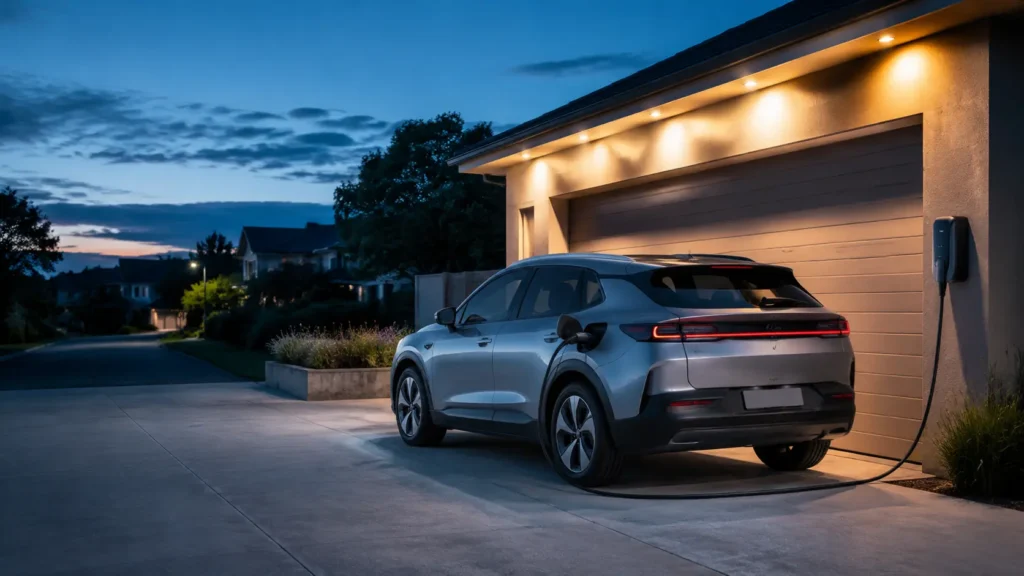
No. A photograph may show a non-U.S. or otherwise different configuration. Confirm the model identifier, vehicle connector, wall plug, voltage, current requirements, certification status, and documentation for the equipment being considered.
Do I need an electrician for a portable EV charger?
Portable equipment still needs an appropriate electrical supply. U.S. Department of Energy guidance recommends checking electrical capacity and applicable installation requirements. When the circuit, outlet condition, or local requirements are uncertain, consult a qualified electrical professional.
Should portability be the first selection criterion?
No. Compatibility, electrical suitability, and documented safety status come first. Weight, cable storage, and carrying convenience should be compared only among chargers that pass the essential checks.
What should I verify immediately before buying?
Verify the exact vehicle connector, wall plug, input requirements, adjustable-current behavior if applicable, cable length, environmental limits, safety certification, included components, U.S. warranty eligibility, and current seller terms. Product-specific details should come from current documentation rather than assumptions based on similar models.
Sources and review notes
Evidence basis: Official-source research. Sources checked: 2026-08-16.